Sunday, 11 November 2012

Japan Trip Update - Week Two


Our second week has seen Ben and I travel from Hokkaido to Honshu and the city of Niigata on the western seaboard. Here we were greeted by Dr. Kurashige, Deputy Director of the Niigata Prefectural Botanic Garden. Three days were spent botaninsing the flora of the Niigata region in some breathtaking locations. The most exciting and memorable being a trek to find the most northerly population of Sciadopitys verticillata in Japan (the Japanese Umbrella Pine). It was a wet day with the mountain cloaked in mist, making it difficult to navigate and assess our progress. Finally however, at 700m we came across a single mature specimen of Sciadopitys, clinging to the steep slope just below the mountain summit. What made it all the more exciting was that it was displaying ripe cones full of seed. On closer inspection, five other semi mature specimens were seen, as well as a small number of juvenile saplings.

Taiga Kuhara - Guide Extrordinaire
Ben Jones next to Sciadopitys verticillata 


Tom, Ben & Sciadopitys - Mission Accomplished!


This species is endemic to Japan, and listed as threatened on the IUCN Red List. Seeing it in the wild was an experience that neither Ben or I will ever forget. Taiga Kuhara, of Niigata Prefectural Botanic Garden, was our guide and made each day an adventure.

Tom & Taiga heading through the forest

We then travelled on to Toyama, further south on the western seaboard, where we were welcomed by Dr. Godo and Mr. Shiuchi. Further field sites were visited including a trek through high altitude Faguscrenata forest. Bells were worn by all to alert our presence to any bears that may have been lurking nearby! Fortunately, none were encountered.

Ben with bells on!
Some of the other forest inhabitants

Our final evening was spent with the Toyama BG management team discussing our plans for next year over traditional Japanese fayre, including sashimi, black squid and some other 'unmentionable' dishes. The project is generating wide interest and support across Japan. Ben and I have been overwhelmed by the hospitality received and with the eagerness to collaborate.

Evening meal with Toyama BG Staff
One of many amazing plants at Toyama BG


Our journey now continues to Kyoto in southern Honshu, Kochi on the island of Shikoku and finally Tokyo and the Kanto region.

Tuesday, 6 November 2012

Japan Trip Update, Week One


Meeting with project partners at Koishikawa Botanic Garden of Tokyo University


Gingko biloba 
Our first full week has seen visits to Koishikawa Botanic Garden of Tokyo University, Shinjuku Gyoen National Garden, followed by a flight up to Sapporo where we visited Hokkaido University Botanic Garden and Tokyo University Forest, Hokkaido.  The visit to Koishikawa Botanic Garden gave Tom and I a chance to meet with other project partners, representing the Ministry of the Environment, Niigata Prefectural Botanic Garden, Tokyo University Botanic Garden and the University of Bonn Botanic Garden.


 Of the plants encountered so far, two stand out in particular. Kalopanax pictus and Tilia japonica. Kalopanax pictus is grown as an important timber tree along with Betula ermanii and seeing it as a large tree, growing in a stand of Picea jezoensis and Abies sachalinensis was quite a sight!

L-R Tom Price, Hirofumi Stubano, Dr. Daisuke Sakue & Ben Jones
The second, Tilia japonica was encountered in a less obvious location – a local noodle bar! The seats were made from this tree, which we hope to encounter in its more usual context as we travel across Japan.

Kalopanax pictus
Bench in noodle bar made from Tilia japonica


At the meeting with other project partners, we gave a presentation, detailing the aims and objectives of the trip over the next two years, and where the outcomes of the project help us deliver the core activities of the University, Garden and Arboretum. The response was very positive with offers of support in the form of guides to accompany us in the field, permit applications, collaborative collecting trips into the field and other logistics. 

View from University of Tokyo Forest, Hokkaido


Saturday, 27 October 2012

Exploring the flora of Japan..

Gardens Curator Tom Price and Arboretum Curator Ben Jones have embarked on their four week field trip to Japan. This, the first of two trips, is part of a project to develop the living collections at the University of Oxford Botanic Garden and Harcourt Arboretum and the University of Oxford Herbaria. 

Japan is one of the 34 global biodiversity hotspots. Collectively these areas hold over 50% of all known plant species, yet cover only 2.3% of the Earth's land surface. The aim of this project is to cultivate plants from Japan at both the Botanic Garden and Harcourt Arboretum to communicate the importance of these biodiversity hotspots and the need for both in situ and ex situ conservation. 

The department is working in collaboration with the Department of Plant Sciences at Oxford, the University of Bonn Botanic Garden and botanic gardens across Japan.

This first trip involves travelling the length and breadth of Japan. From Hokkaido in the north to Shikoku in the south, via Tokyo, Niigata, Toyama and Kyoto. At each stop meetings are being held with botanic garden staff to establish seed collection sites of endemic plant species. These sites will be revisited in 2013 for the collection of seed and supporting herbarium specimens.

The Botanic Garden and Harcourt Arboretum are extremely grateful to the Impey family for their generous donation and to the Friends of the Botanic Garden and Harcourt Arboretum whose collective generosity has funded this trip.

Tom and Ben will be posting regular updates here on their progress over the next four weeks. Watch this space!

Friday, 12 October 2012

Naked Ladies Provide Gout Cure

The oncology bed of the Botanic Garden's medicinal plant collection has been glowing with colour in the autumn sun. The source of this radiance is the autumn crocus, Colchicum autumnale. Along with several other bulbs, its habit of flowering before the appearance of any foliage has earned it the common name 'Naked Ladies.' The mythical origin of this plant has it springing forth from drops of a magical potion concocted by the sorceress Medea to restore youth to Aeson. As this myth suggests, the medicinal properties of Colchicum have been known about for some time. In fact, it is first mentioned in the Ancient Egyptian Ebers Papyrus three and a half thousand years ago.

Colchicum autumnale  flowering on the oncology bed
The medicinal uses of this plant have not changed over the millennia- it is still used for the treatment of gout and joint pain. Modern medicine is researching its potential as an anti-cancer drug. As with many medicinal plants, the genus is extremely toxic and should never be confused, despite its common names, for the autumn-flowering Saffron Crocus, Crocus sativus. The stamens of the latter are an astronomically expensive condiment. In Crocus species there are only three stamens whereas Colchicum species have six.

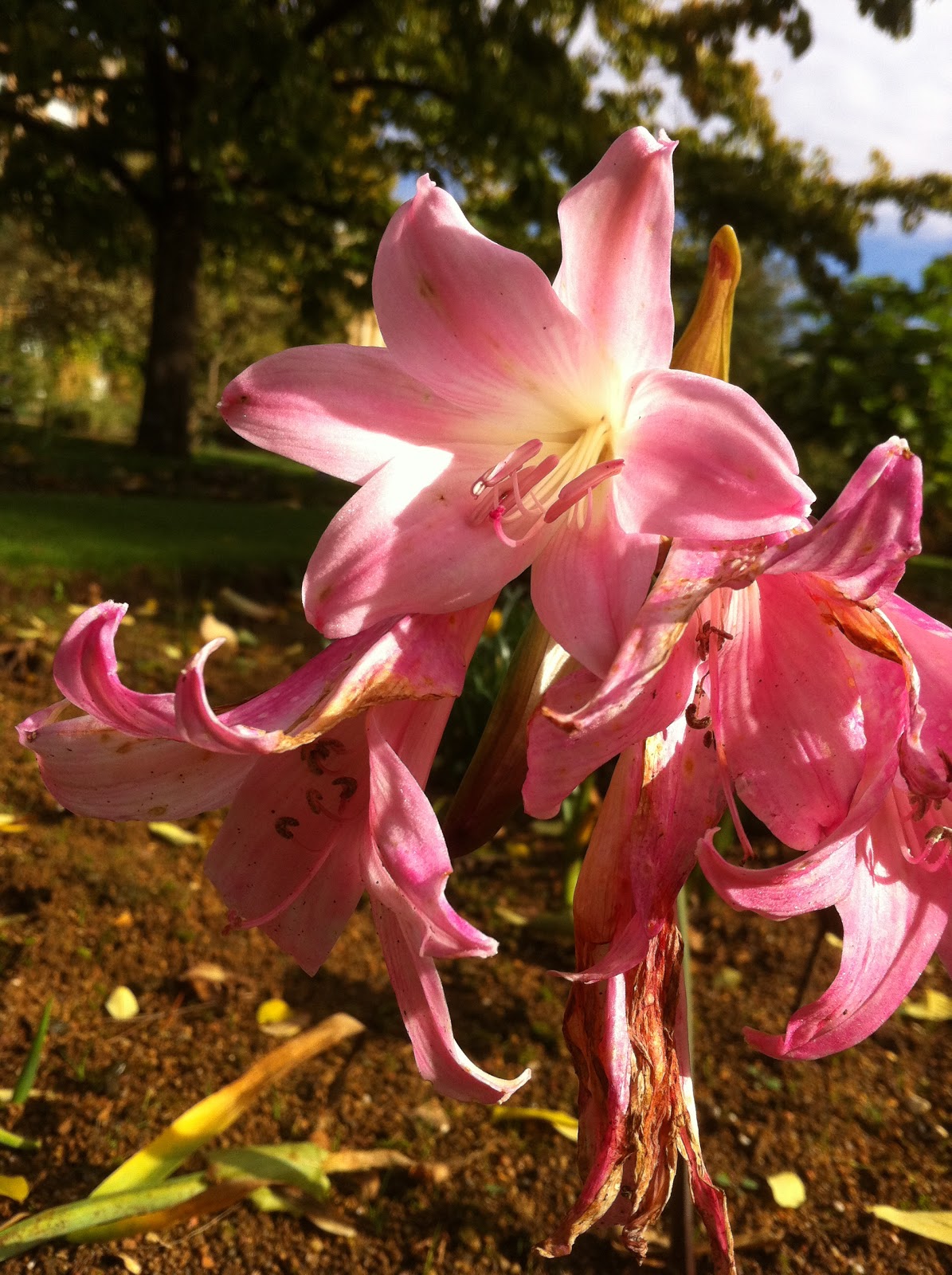
Amaryllis belladonna


Amaryllis belladonna is flowering now on the family beds. In its native South Africa it is known as the March Lily, reflecting the Southern hemisphere month of its flowering. But the lack of accompanying foliage gives it another common name - 'Naked Ladies.' Now, it is worth pointing out that Amaryllis belladonna belongs to an entirely different family from Colchicum. Unlike Colchicum, it does not contain the active chemical Colchicine and has no application in the treatment of gout or in cancer research. This, of course, is an example of the confusion that scientific names were coined to avoid.

Sunday, 7 October 2012

Umbel Relations

  Apiaceae, the carrot family, is well represented at the Botanic Garden. A huge family of annual, biennial and perennial plants with a global distribution, Apiaceae is characterised by its distinctive inflorescence - the umbel, which gave the family its former name of Umbelliferae. From familiar foods, such as carrot and parsnip, to the striking architecture of the ornamentals Eryngium and Bupleurum, to toxic and invasive weeds like Giant Hogweed(Heracleum mantegazzianum), the family is rich in variety and uses. 


Eryngium paniculatum on the Apiaceae bed
  Three species of Eryngium have germinated on the Merton borders with E. planum 'Blaukappe' producing spectacular, metallic blue inflorescences. E. maritimum, our native sea holly, has germinated well. Its thick, glaucous foliage can be seen dotted across the borders. The candied roots of this species were considered aphrodisiac in Elizabethan England.


Eryngium planum 'Blaukappe'
  Of the many Apiaceae species native to the British Isles several are threatened by changing patterns of land use. Sium latifolium, the Greater Water-parsnip, is a native plant found in the rafts of fen vegetation that build up on the margins of rivers and lakes. Modern approaches to the management of waterways have made such habitats increasingly rare. Now the Greater Water-parsnip is mostly confined to drainage ditches adjacent to arable land and is nationally scarce. The Oxford Rare Plants Group is active in the conservation of many threatened species in Oxfordshire including Sium latifolium. The Botanic Garden will be working with the Oxford Rare Plants Group to collect the seed of this plant for germination trials at the garden. More seed will be sent to the Millenium Seed Bank for long-term storage.


The nationally scarce Greater Water-parsnip
Sium latifolium


Friday, 28 September 2012

Braving the elements (in more ways than one)

As gardeners we are all used to dealing with "the elements"on a daily basis - braving whatever the weather throws at us. Never has this been more true than this year. However, at the University of Oxford Botanic Garden we are a positive lot and thought we'd embrace "the elements" - but in a different way altogether.

Following on from a successful collaboration with our colleagues in the Department of Chemistry (the other "Elements") in 2011 to celebrate International Year of Chemistry, we have teamed up once again to deliver a new audio trail entitled "Chemistry at the Garden" which is available free of charge to all our visitors. During the summer, a group of enthusiastic science communicators got together to record the audio trail on location at the Garden. Helped by the very patient Josh from the University podcast team, we told the stories of how plants have provided inspiration for chemistry research both in the past and still today.


The audio trail leads you around the Garden, where, at the appropriate places you trigger the sound by pointing the nib of the audio pen on a specially designed map. You can hear about photosynthesis, how the lotus plant has inspired the development of new materials, what makes the wonderful caramel smell that is wafting across the Botanic Garden on sunny days at this time of year and how the plants at the Garden helped an Oxford chemist win a Nobel prize.
Each of the trail stops lasts just a few minutes and gives you an insight into what motivates the research chemists to pursue their work.


The new audio trail was launched on the 13th September. The weather was kind and all those who came had fun exploring the collections with the audio trail. 

Another fantastic group who have braved "the elements" over the spring and summer are the volunteers who have been working at the Garden alongside our team of botanical horticulturalists. This year we have welcomed almost thirty gardeners and weeders who have enabled us to tame the weeds in the face of one of the wettest summers on record. Their help has been invaluable in keeping our worst weed (Nothoscordum) under control and their never ending enthusiasm to eradicate this beast is much appreciated. On Wednesday this week we said a proper thank you to all our volunteers (whether office based or practical, Garden or Arboretum) as well as all those who have given their time to support the Friends of the Botanic Garden and Harcourt Arboretum over the past year. This occasion was marked  of course by tea and cake (and more cake).


After consuming our bodyweight in cake we finished with a walk around the Botanic Garden, led by Gardens curator Tom Price.

It seemed only appropriate that is was pouring with rain!

Sunday, 2 September 2012

Keys at the Sea

The Botanic Garden is a living collection of plants and, like any museum collection, it is important to know exactly what we are looking at. Plants can be identified in a number of ways- often it is enough to see a plant once and be told what it is to establish familiarity for life. Often it is possible to match the living plant to a picture or photograph in a guide. An image search on the internet, however, may provide us with a variety of plants from widely different families, all sharing the same name. It is obvious that identification has to come from an authoritative source. Luckily for botanists and gardeners this source exists in the form of comprehensive floras of native and garden plants. It was to gain experience in using these guides that staff from the Garden team attended a recent course in identifying coastal plants run by the Field Studies Council.
Saltmarsh at Shingle Street, Suffolk

Which Salicornia is which? 
The course took place in Suffolk under the expert tuition of Ros Bennett. Staff from the Botanic Garden joined other students in an effort to identify various coastal plants, mainly using the key from Stace's New Flora of the British Isles. A key of this kind lets the user choose between two descriptions of a plant. The chosen description will lead to another pair of descriptions, and so on, until the plant has been identified to the level of family, genus or species. Often the key features in these descriptions require a hand lens to be visible. The curious naturalist discovers a hidden world of microscopic beauty. 

Many beautiful plants grow in the ever-changing landscape of the salt marshes and shingle. Obviously, many are adapted to the high levels of salt and the regularly inundated mud of estuaries. While these plants may be impossible to grow in Oxford some, such as Sea Lavender (Limonium) and Sea Kale (Crambe maritima) are thriving in the garden.
In any case, learning how to use a flora allows us to identify plants from any habitat and encourages to look at the wonderful variety of detail that makes every plant species unique.